

Test your defenses against real-world attack scenarios - before attackers do
Penetration testing - controlled simulation of real cyberattacks on your IT infrastructure, applications, networks, and devices – delivering actionable findings, proven exploits, and clear remediation guidance.
Having security tools in place doesn’t mean you’re truly secure. Many organizations invest in protection but never validate its effectiveness in real conditions. Meanwhile, attackers continuously probe for weaknesses – methodically and without warning. Penetration testing reverses that dynamic: you attack first, in a controlled environment, with full visibility and a comprehensive report.

What is penetration testing?
Penetration testing (pentesting) is an ethical, controlled simulation of real-world attacks on an organization’s IT systems. Unlike automated vulnerability scans, pentests involve experienced security experts who think and act like attackers – attempting to bypass defenses, escalate privileges, and access protected assets.
The result is not just a list of vulnerabilities, but verified proof of exploitability – enabling effective risk prioritization and remediation.
What areas does penetration testing cover?
- Infrastructure and application testing – servers, networks, and web applications against known and unknown attack techniques.
- Mobile application testing – security of iOS and Android apps, including authentication and data storage.
- Wireless (Wi-Fi) testing – configuration review, rogue access point detection, protocol weaknesses.
- Hardware and IoT testing – security of devices, terminals, and network equipment.
- Code review and analysis – manual and automated analysis of source code for vulnerabilities.
- Red Team engagements – advanced multi-vector attack simulations (technology, processes, people).
- Attack surface analysis – identification of all externally exposed assets and entry points.
Why is penetration testingessential?
Firewalls, EDR, or SIEM alone do not guarantee security – they must be properly configured, integrated, and validated. Every change in IT – new systems, updates, configuration changes – can introduce new risks.
Regular penetration testing enables you to:
- Validate security effectiveness in real-world scenarios.
- Identify vulnerabilities missed by automated tools- requiring human judgment and creativity.
- Meet regulatory requirements - NIS2, PCI-DSS, ISO 27001 require regular security testing.
- Reduce financial and reputational risk - the cost of pentesting is many times lower than the cost of handling an actual incident.
- Provide management with clear, evidence-based insights to make investment decisions in the area of security.

How does penetration testing work?
Each engagement follows a structured, transparent process:
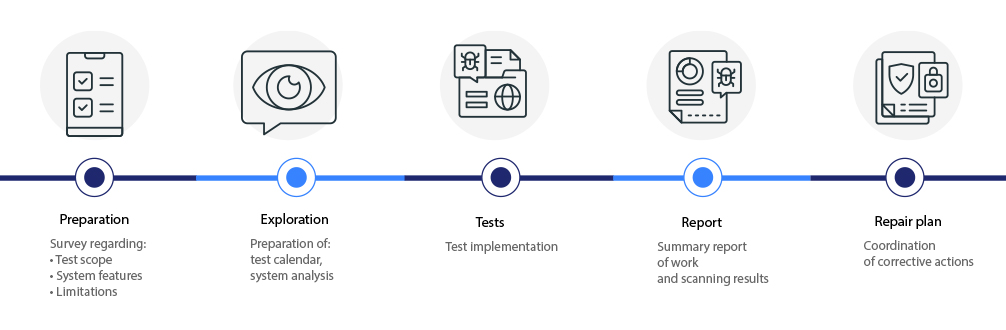
1. Scoping and objectives – define systems, rules of engagement, and success criteria.
2. Reconnaissance – gather intelligence from an attacker’s perspective.
3. Vulnerability identification – detect potential attack vectors.
4. Exploitation – safely exploit vulnerabilities to validate risk.
5. Reporting – detailed report with findings, proof of exploitation, risk ratings (CVSS), and remediation guidance for both technical teams and management.
6. Post-test support – assistance with remediation and validation of fixes.
Who is penetration testing for?
Penetration testing is especially valuable for organizations that:
- Develop web or mobile applications and need security validation before release.
- Must comply with regulations — NIS2, PCI-DSS, ISO 27001.
- Have implemented new systems or infrastructure.
- Haven’t conducted security testing in over a year.
- Need evidence-based justification for security investments.
Penetration testing by Knoxtera
As an integrated approach to assessing the security of IT systems
Penetration testing is a controlled attempt at a real attack that allows you to verify the effectiveness of security measures in practice, not just at the declarative level. An integrated approach to assessing the security of IT systems combines technical testing with process and risk analysis, providing management with clear recommendations and action priorities.
- Infrastructure and application testing
- Wireless (Wi-Fi) testing
- Hardware and device testing
- Code review and analysis
- Red Team operations
- Attack surface analysis
Explore Our Other Services

SOC – Security Operations Center
With us, you gain continuous security monitoring that enables rapid detection and mitigation of threats through 24/7 supervision of your systems and networks.
You also benefit from advanced behavioral analytics, enabling real-time anomaly detection and threat identification.

SIEM – Security Information and Event Management
Every organization generates thousands of security events daily. Without the right tools, most go unnoticed until it’s too late. SIEM aggregates data from across your infrastructure, correlates events, and identifies real threats before they escalate into incidents.

Want to know if your infrastructure is
truly secure?
Talk to our experts and find out which penetration testing scope best fits your organization.
We respond within 24 hours.