

Cybersecurity is an investment – not a cost
Most conversations about implementing a SOC end with the same question from the board: “How much does it cost?”. However, this question is framed backwards. The more appropriate question is: “How much does not having a SOC cost us?”
A Security Operations Center (SOC) is not just another IT expense, but a strategic tool for financial risk management. In practice, companies that choose the SOC-as-a-Service model do more than just protect their assets more effectively. Above all, they avoid losses that, in the event of a serious incident, many times exceed the cost of year-round protection.
Therefore, in the following article, we will show you step-by-step how to calculate the ROI from implementing Knoxter SOC. Importantly, we rely on specific numbers and a methodology used by leading security analysts worldwide.
Why SOC ROI is measurable
Unfortunately, many companies treat cybersecurity as a dead cost, failing to see the return on investment. However, it must be acknowledged that this is a mistake, as the cost of a security incident can be precisely calculated. In practice, a reliable financial analysis allows for the determination of this risk and the actual losses to business continuity. As a result, modern organizations see protection not as an expense, but as an effective safeguard for their capital.
We calculate the ROI of a SOC as the difference between:
- the value of losses avoided thanks to rapid detection and response,
- the cost of the SOC service itself.
If the value of avoided losses is higher than the cost of the SOC – the investment pays off. In practice, it pays off many times over.
Component 1: How much does a security incident really cost?
Before we calculate ROI, we must understand what constitutes the cost of a cyberattack. It is not just about data recovery – it is the sum of many items that organizations often overlook in their calculations.
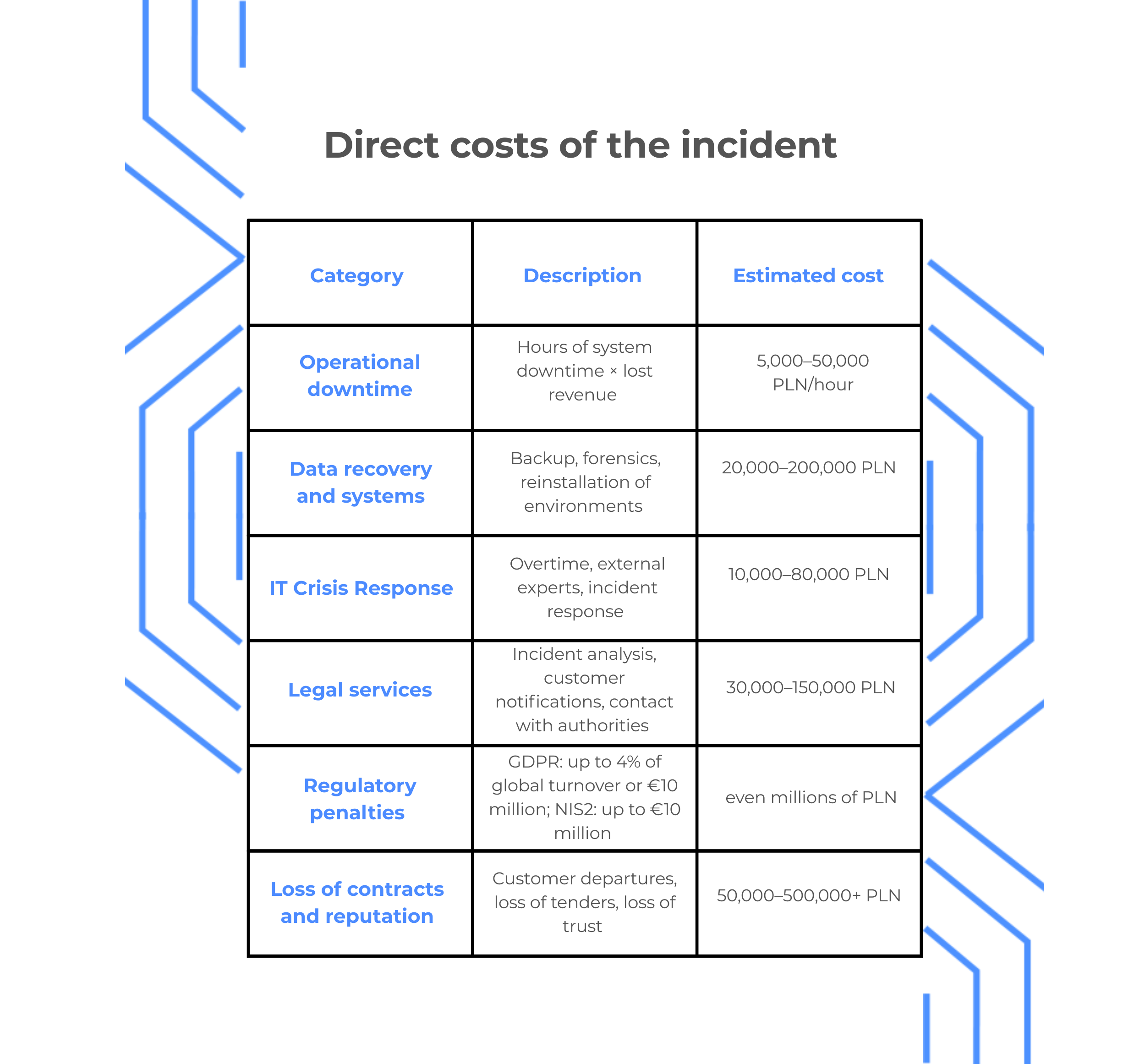
Hidden costs that we most often overlook
Beyond direct losses, costs arise that are harder to quantify but equally real:
- the increase in insurance premiums following an incident,
- the increase in insurance premiums following an incident,
- the decline in employee productivity during a crisis,
- long-term reputational damage impacting sales.
According to raportu IBM Cost of a Data Breach 2023, the average total cost of a data breach globally reached $4.45 million – a record high in the study's history. In the financial and healthcare sectors, these costs are often twice as high.
Component 2: Probability of an incident – Annualized Loss Expectancy (ALE)
Nie każda firma doświadcza ataku każdego roku.
Dlatego In our ROI analysis, we apply the ALE (Annualized Loss Expectancy) methodology – representing the expected annual loss:
ALE=SLE×AROALE=SLE×ARO
Where:
- SLE (Single Loss Expectancy) – the cost of a single incident,
- ARO (Annualized Rate of Occurrence) – the probability of an incident occurring in a given year.
Przykład dla firmy produkcyjnej zatrudniającej 200 osób:
ALE=800,000 PLN×0.30=240,000 PLN/year
This means the company "risks" losing PLN 240,000 annually—even if an attack does not occur in that specific year. This amount should be the starting point for evaluating the financial viability of an investment in a SOC.
Component 3: Cost of SOC-as-a-Service vs. In-house SOC
One of the strongest arguments for Knoxtera A SOC is a comparison of security model costs. Building an internal security operations center is an investment that only the largest corporations can afford.
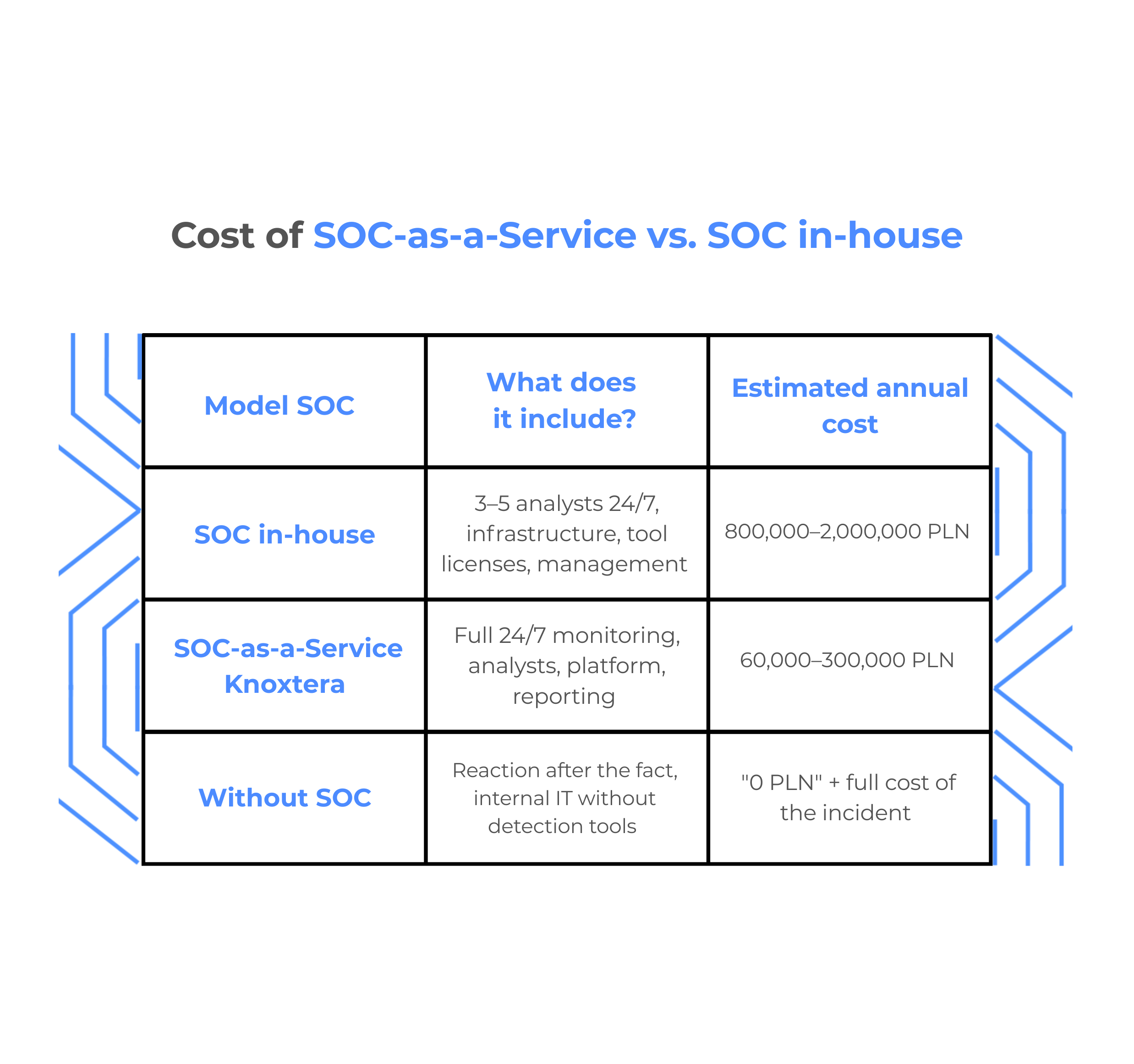
HTML It is worth emphasizing that the difference in costs between an in-house model and the Knoxtera SOC solution often exceeds one million PLN annually. Importantly, this amount only covers operational expenses, meaning it does not yet include the potentially enormous losses resulting from possible incidents. Consequently, choosing external support becomes not only safer, but also significantly more economically effective.
Component 4: The Impact of Detection Time on Incident Costs
Tu leży jeden z najsilniejszych argumentów za SOC działającym w trybie 24/7. Im szybciej wykryty incydent – tym niższy koszt.
Importantly, market data (including IBM reports) unequivocally confirms this correlation. In practice, organizations that detected a breach in fewer than 200 days suffered losses averaging $1.02 million less than companies where the detection process took longer. Consequently, response speed becomes a key factor determining the financial stability of an enterprise after an attack.
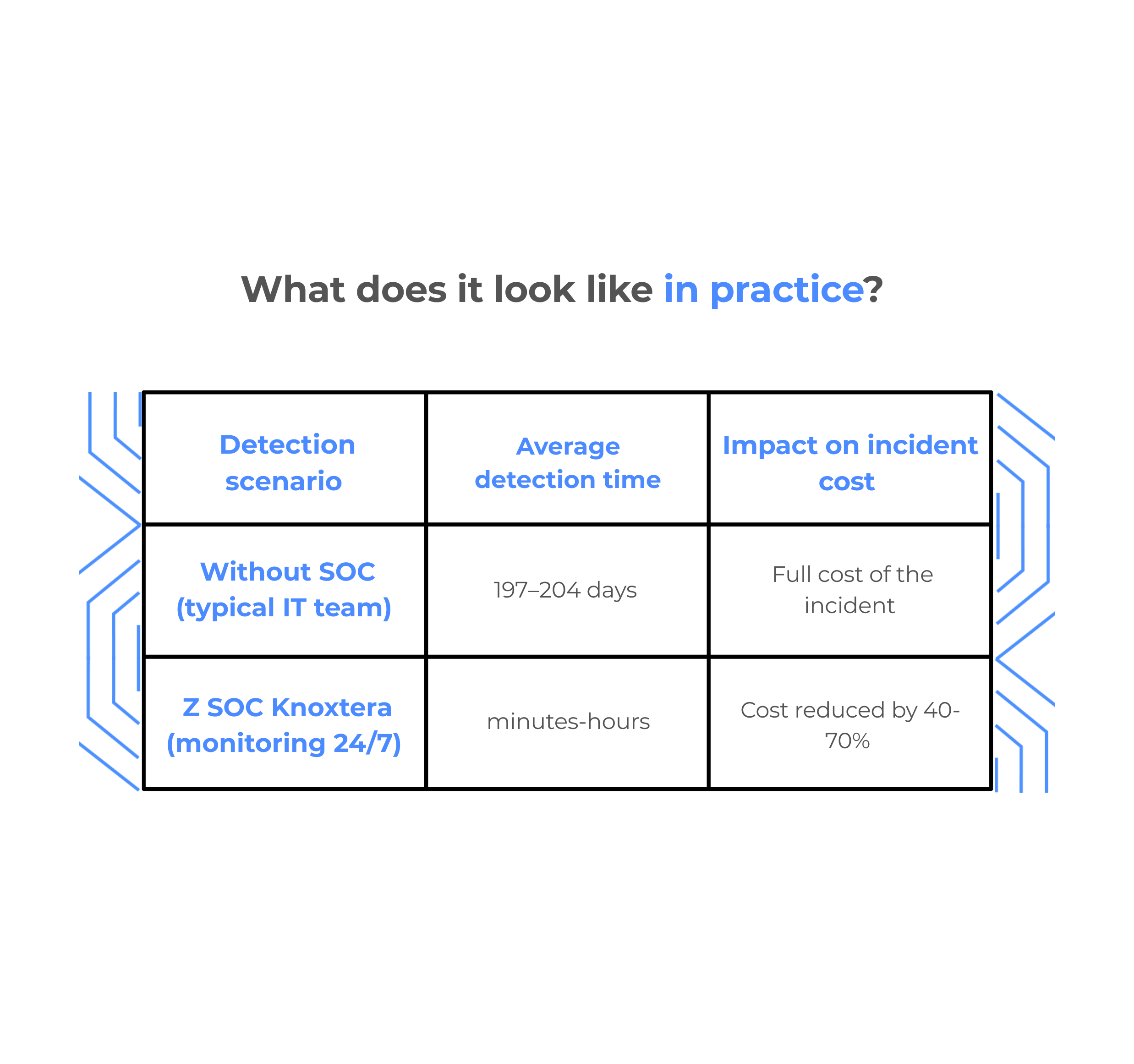
Every hour that goes by without a threat being detected is time during which an attacker can expand their access, encrypt data and cover their tracks. A SOC reduces this window to a minimum.
SOC ROI Calculator: A Step-by-Step Example
Below is a complete calculation for a medium-sized B2B company, 200 employees, manufacturing sector:
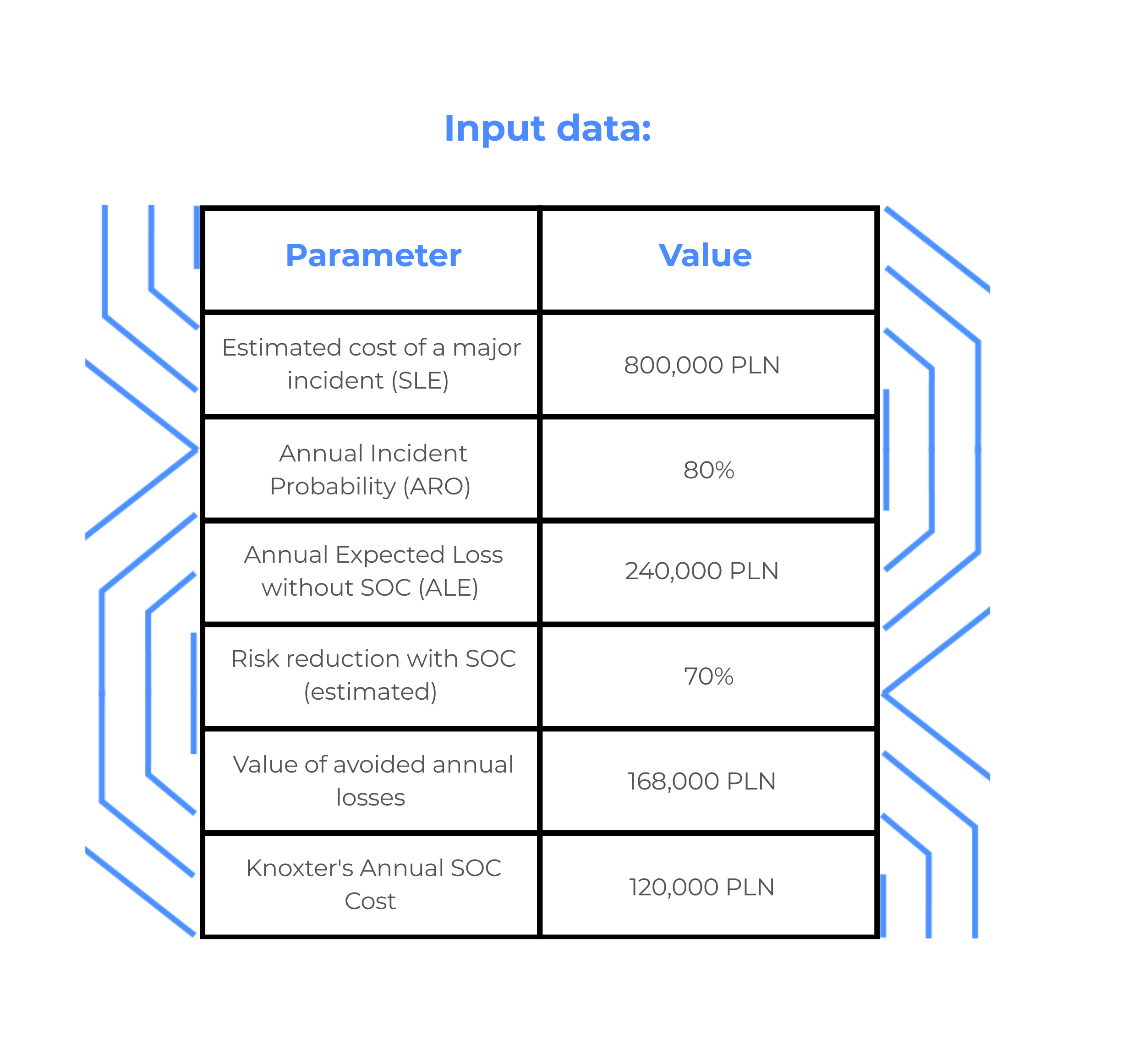
This is a conservative calculation – it does not take into account:
- avoided GDPR and NIS2 fines,
- savings vs. the in-house model,
- reputational value and contract retention.
After including these elements, the ROI in real-world implementations consistently exceeds 200–400%.
SOC and compliance with NIS2 and GDPR – an additional dimension of ROI
It is worth recalling that the NIS2 directive imposes a rigorous obligation on key sectors to detect and respond to incidents. Unfortunately, disregarding these regulations carries the risk of fines of up to €10 million or 2% of global turnover.
This is precisely why Knoxter's SOC-as-a-Service model effectively supports NIS2 and GDPR compliance through:
- całodobowy monitoring i rzetelną dokumentację zdarzeń,
- automated reporting in compliance with regulatory requirements,
- reducing response times below statutory notification thresholds.
As a result, in the era of new regulations, implementing a SOC becomes an essential compliance cost rather than just an optional IT expense. Consequently, the nature of the conversation with the board of directors is changing. Instead of asking: "can we afford this?", managers today must answer the question: "can we afford the risk of not having a SOC?"
Summary: SOC as a Financial Decision
Wybór modelu usługowego to przede wszystkim decyzja biznesowa
W związku z tym warto przyjrzeć się kluczowym argumentom finansowym, które przemawiają za tym rozwiązaniem:
- First and foremost, the average cost of a single incident in Europe now exceeds €1 million. This amount is many times higher than the annual expenditure on a professional SOC.
- Moreover, lightning-fast threat detection effectively reduces the cost of a potential attack by 40–70%.
- In turn, the as-a-Service model proves to be 5 to 10 times cheaper than building and maintaining your own independent operations center.
- At the same time, full compliance with the NIS2 directive and GDPR completely eliminates the risk of regulatory fines, which can reach millions of euros.