

SOC is not a tool or a one-off implementation project. It is an organisation’s ongoing capability to detect, analyse and manage security incidents.
That is precisely why choosing the right operating system is so important.
Of course, some companies choose to set up their own security centre. However, for many others, SOC-as-a-Service is a more sensible option. Under this model, an external partner provides the necessary expertise and round-the-clock monitoring.
Consequently, the most important question is not about the prestige of a particular solution. The key issue is which model will provide the company with a genuine ability to respond — szybciej, skuteczniej i w przewidywalnym koszcie.
SOC is an operational capability, not the purchase of technology
One of the most common misconceptions about a SOC is to view it merely as a tool. Organisations often equate a SOC with implementing a SIEM, setting up a dashboard or collecting logs. This is merely a small part of the bigger picture.
A true SOC is a combination of four elements:
- people who analyse alerts, conduct investigations and respond to incidents,
- processes that govern the classification of incidents, escalation and collaboration with IT,
- technologies such as SIEM, EDR/XDR, SOAR, threat intelligence and log management,
- an operational model that operates not only during working hours, but also when attacks actually occur — including at night, at weekends and on public holidays.
This means that The decision to build your own SOC is not the same as deciding to purchase a platform, but about building and maintaining the entire operational structure.
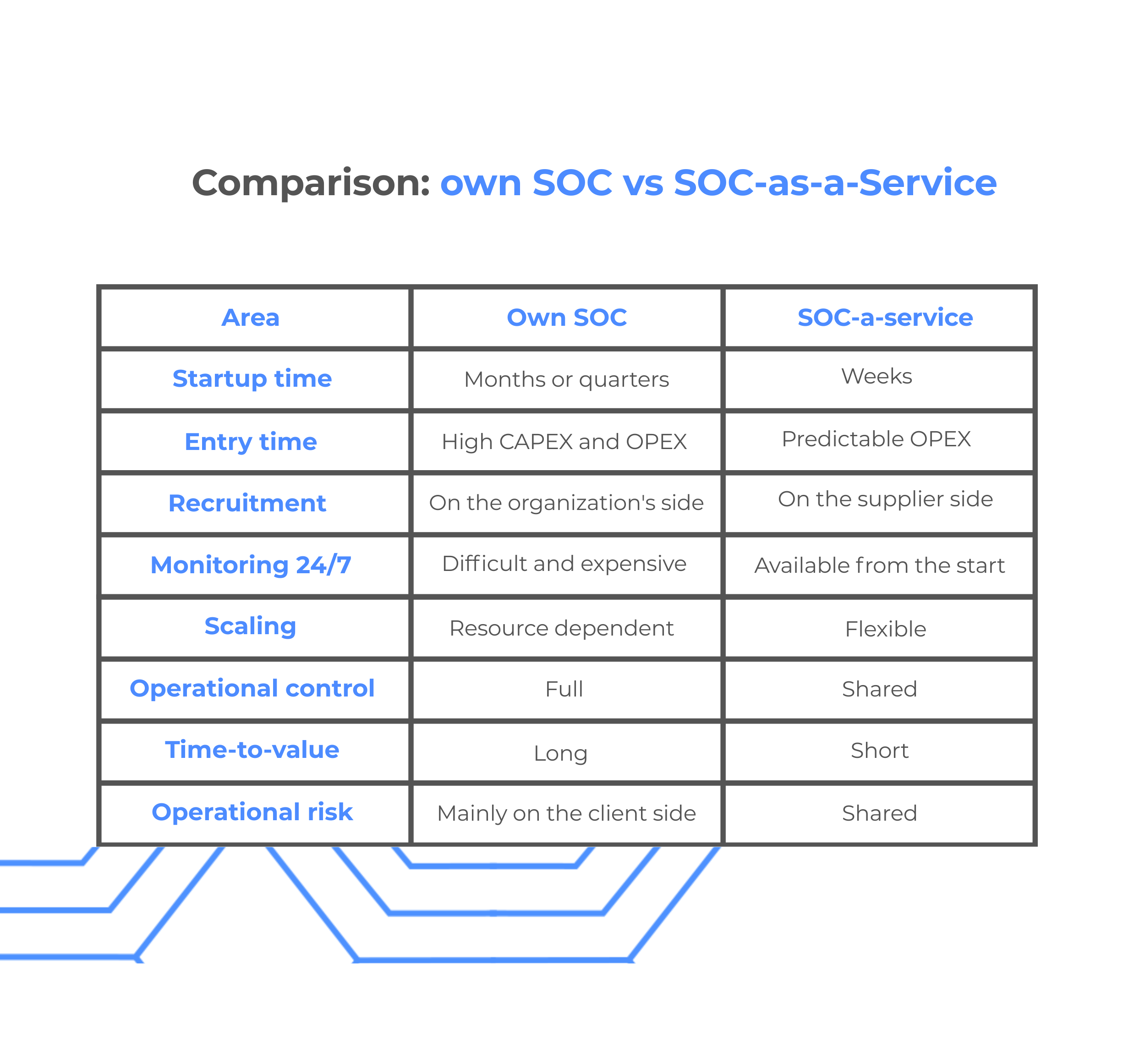
How does an on-premises SOC differ from SOC-as-a-Service?
Put simply, the difference boils down to this question: who builds, maintains and develops the SOC’s operational capability?
In the in-house model, the organisation assumes full responsibility for:
- recruiting and retaining a team of analysts,
- selection and maintenance of technology,
- the development of operational procedures and incident management,
- the development of detection scenarios and capabilities threat huntingu.
There is no doubt that this solution ensures the highest level of control over processes; however, it entails a huge operational burden.
SOC-as-a-Service, on the other hand, allows an organisation to utilise ready-made operational capabilities provided by an external partner. This model primarily includes:
- 24-hour security monitoring,
- professional analysis of alerts,
- ready-made processes and expert support.
What’s more, this approach allows for a rapid launch without the need to build a team from scratch. As a result, the service model effectively lowers the barrier to entry and drastically reduces the time it takes to achieve real business value.
When should you consider setting up your own SOC?
Należy uznać, że własny SOC ma sens, jednak nie w każdej organizacji. Rozwiązanie to sprawdza się najlepiej wtedy, gdy bezpieczeństwo operacyjne stanowi strategiczną funkcję firmy, a skala jej działania uzasadnia tak dużą inwestycję.
Consequently It is worth considering building an internal centre in specific cases, when:
- firma działa w skali enterprise and has a complex, a multi-level infrastructure,
- The IT environment comprises systems legacy, environment OT or custom integrations,
- the organisation has already achieved a high level of process maturity incident response,
- The management requires full control over the logs, data and proprietary detection rules,
- the company has the budget to maintain a team of experts available around the clock, rather than just the technology itself.
In practice, having an in-house SOC makes sense primarily where the scale, regulatory requirements and complexity of the environment justify ongoing investment in a dedicated team and security processes.
What are the practical requirements for setting up your own SOC?
Jakie są praktyczne wymagania dotyczące utworzenia własnego centrum operacyjnego bezpieczeństwa (SOC)?
People
A minimum operational model typically requires roles such as:
- L1 analysts responsible for monitoring and triage,
- L2/L3 analysts responsible for in-depth analysis and escalation,
- incident responder supporting incident response,
- a detection engineer developing rules and use cases,
- SOC manager or the person responsible for the overall operational management.
If the SOC is to operate 24/7, it requires shift work, staff interchangeability and an appropriate level of skills redundancy. This means that the actual team is larger than organisations initially anticipate.
Processes
Without processes, even a good team and good technology cannot create a SOC. Among other things, the following are required:
- alert classification procedures,
- clear escalation procedures,
- incident response playbooks,
- integration with the IT team, helpdesk and compliance department,
- a reporting model, KPIs and regular performance reviews.
- Technology
SOC requires not just a single tool, but an entire technology stack. In practice, this usually includes:
- An event correlation and analysis system,
- EDR/XDR for endpoint monitoring,
- SOAR for automating selected reactions,
- threat intelligence sources,
- ticket system and knowledge base,
- log management platforms and integrations with client systems.
Operations
Even after the environment has been set up, the work is not over. The SOC requires ongoing maintenance:
- updating detection rules,
- adapting use cases to changes in the environment,
- validation of alerts and reduction of false positives,
- training and maintaining the team’s skills,
- effectiveness and operational readiness reviews.
- It is this operational layer that many organisations find the most challenging.
When SOC-as-a-Service is the better choice
For most companies, the question is not ‘Do we have the ambition to build a SOC?’, but ‘How can we achieve effective detection and response capabilities as quickly as possible?’
SOC-as-a-Service is usually the better choice when:
- the organisation wants to get security monitoring up and running quickly,
- there is no budget or business case for a dedicated 24/7 team,
- recruiting SOC specialists is difficult or impractical,
- the current IT/security team is overburdened with operational tasks,
- the company needs predictable costs and a service model,
- the environment is distributed, cloud-based or hybrid and requires rapid organisation of monitoring,
- The aim is operational efficiency, not building up extensive in-house expertise.
In practice, the service model gives an organisation a faster start, lower implementation risk and access to expertise that would be difficult to build up in-house within a reasonable timeframe.
The most common mistake: “We’re building a SOC”, but in practice we’re only implementing a SIEM
This is one of the most common scenarios in organisations that launch SOC initiatives without fully realising the scale of the project.
A company implements a SIEM, integrates several log sources, builds dashboards, and concludes that it ‘has a SOC’. The problem is that:
- there is no 24-hour surveillance,
- there is no team to analyse alerts,
- there are no established playbooks,
- there is no reaction process,
- there is no regular development of detection rules,
- there is no operational owner on the security side.
In such a situation, the organisation has an analytics platform but lacks a genuine SOC operational capability. This is an important distinction, as it is precisely this that determines effectiveness in the event of an actual incident.
The hybrid model: a sensible middle ground
Not every organisation has to choose between full outsourcing and a fully in-house model. Increasingly, a hybrid model is proving to be the best solution.
In this approach:
- the in-house IT/security team retains control over the environment and business decisions,
- the external partner provides 24/7 monitoring, analysis and expert support,
- The organisation can develop its own security capabilities without having to build an entire SOC from scratch.
This is a good model for companies that want to strengthen their own capabilities but are unwilling or unable to maintain a fully-fledged SOC operation on their own.
How to make a decision: questions to ask yourself
Czy mamy wystarczającą liczbę pracowników?
- Do we have enough staff?
- Do we have specialists capable of working on a 24/7 basis?
- Are we able to recruit and retain SOC analysts?
- Do we have expertise in detection engineering and incident response?
- Do we have any trials?
- Do we have incident response playbooks in place?
- Do alerts have owners and escalation paths?
- Is security integrated with operational IT and compliance?
- Do we have the time and the budget?
- Can we wait a few months for the system to become operational?
- Does the budget cover not only technology, but also people and skills development?
- Do we want to invest in security as a strategic capability, or do we need to mitigate risk quickly?
If the answers to these questions are unclear, the service model very often proves to be the safer and more sensible choice.
In summary: you’re not choosing a model for prestige, but a model for effectiveness
The decision between an in-house SOC and SOC-as-a-Service should not be driven by technological ambition or market trends. It should be based on a realistic assessment:
- the scale of the organisation,
- process maturity,
- available resources,
- business needs,
- and the expected time for the effect to take hold.
For some large organisations, having their own SOC will be the right approach. For most companies, SOC-as-a-Service will be the faster, safer and more predictable option — especially when the key priority is the actual ability to detect and respond, rather than simply having in-house operations.
What are the practical requirements for setting up your own Security Operations Centre (SOC)?